A tombstone opening has a round arch on top and a flat bottom with two small corners; an obround has a half-circle at each end. For the same clear width the hand check of VIII-2 4.5.17.3 gives the same answer for both, because it sees only the width across the load path. The shell model sees the corners, and that is where the two shapes differ.
This post compares the two shapes, the hand check that treats them alike, and what the model reads.
The two shapes
- Tombstone: a semicircular arch on top, straight sides, and a flat bottom whose two corners have a given outside radius, at least the sleeve wall and at most half the width.
- Obround: two semicircles joined by straight sides, the long axis usually vertical on a skirt.
- Round: a plain circle, for smaller openings.
Each is framed by a sleeve: the outside size is the clear size plus twice the sleeve wall, and the sleeve's mid-surface is the outside curve offset by half its wall. Sleeve projections outside and inside, a pad and vertical stiffener bars either side are inputs. The tombstone's flat bottom gives more clear room at the base for the same height.
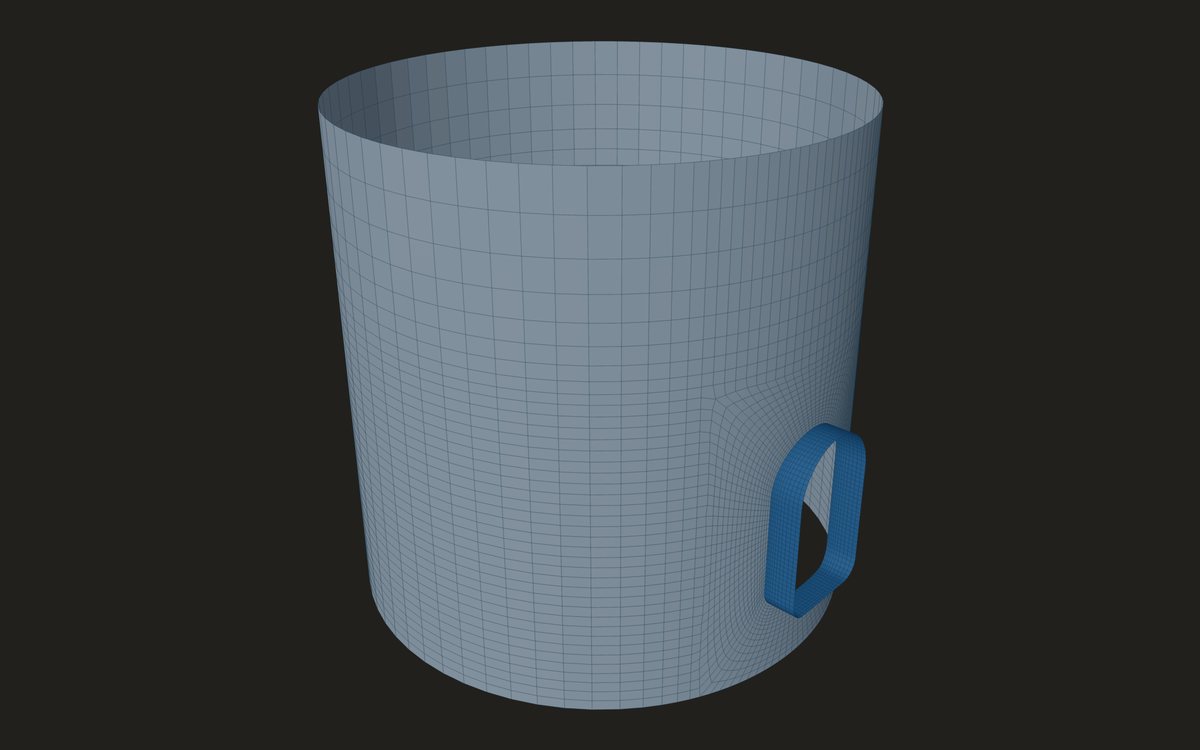
What the opening does to the load path
The skirt carries the weight and the overturning moment as axial compression. An opening cuts out a piece of that path. The wall either side takes the load the opening removed, and the ends of the opening, top and bottom, are where the flow turns round it.
The tighter the curve at an end, the sharper the turn and the higher the local stress. An obround's ends are full half-circles of the opening's half-width. A tombstone's arch is the same at the top, but its bottom has two corners of a much smaller radius. Those corners sit low in the skirt, where the overturning moment is largest, so they are the first place to look on a tombstone.
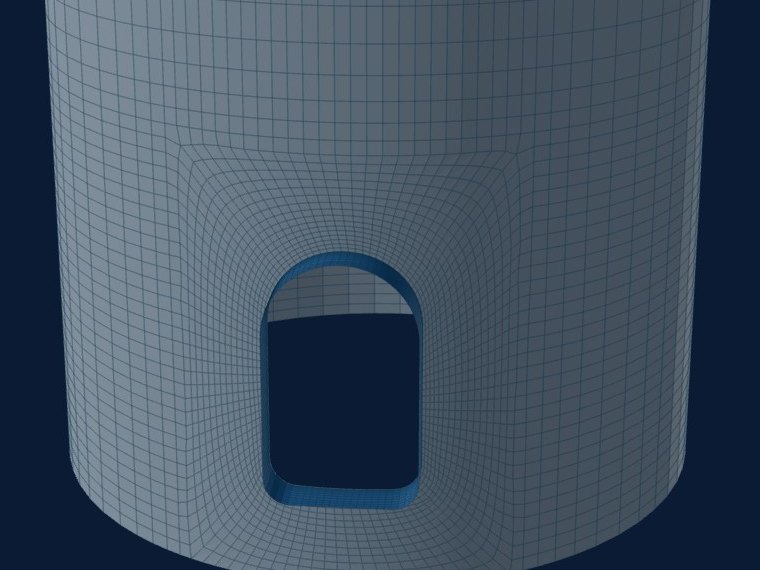
The hand check treats them alike
VIII-2 4.5.17.3 replaces area for an opening under axial compression. The required area depends on the clear width d across the load path and the required wall t_r; the available area counts the shell either side within 0.75√(R·t), the sleeve outside and inside, the welds and the pad. None of that depends on the shape of the ends.
The required wall is taken at the opening's centre height, where the overturning moment has already dropped by the base shear times that height: M(z) = M − V·z. For the example skirt, an opening 1000 mm high starting 450 mm above the base has its centre at 950 mm, and a base moment of 2400 kN·m with 120 kN of shear gives 2286 kN·m there. The check is also made at the base. An opening wider than a quarter of the skirt diameter is flagged, since the rule does not apply beyond that.
What the model adds
The shell model spans the skirt from the base ring to the head joint, both lines of support. The loads are placed so that the opening side is in compression whatever its angle, and the reverse case is checked too. Above the opening the stress agrees with beam theory within 5 %, which a test confirms. At the opening the model reads the sleeve-to-skirt junction all round, including the tombstone's corners, and runs a buckling analysis every time.
A larger corner radius on a tombstone eases the bottom corners. Stiffener bars either side add stiffness to the wall beside the opening, and need about 200 mm clear to mesh. Each can be tried in the model and its effect read at the corner.
Where it stops
- 01The base ring, anchor chairs, gussets and the skirt-to-head weld detail are not modelled; the ring and the head joint are lines of support.
- 02Only the 25 % diameter limit of 4.5.17.1 is checked; the 80 % ring-spacing limit is not.
- 03Stiffener bars tight against the sleeve and a ring on the sleeve end are not offered yet.
- 04The shell model and its buckling result are early access and under verification.
Try it in FEXLA
The Skirt access opening card builds a tombstone, obround or round opening with its sleeve and pad, runs the 4.5.17.3 hand check and the buckling analysis.
Open the cardReferences
- ASME Section VIII Division 2, 4.5.17.1 and 4.5.17.3 (openings under axial compression).
- ASME Section VIII Division 2, 5.4 (buckling).
Method notes this draws on
Next post: Skirt buckling under weight and wind, with the design factors
Educational article. It explains principles and is not design guidance; follow your governing code and edition.