Where a head meets a cylindrical shell, the two parts would grow by different amounts under pressure, so a shear force and a moment appear at the joint to make them fit. How large they are depends on the head: small for a hemisphere, larger for an ellipsoidal or torispherical head, whose knuckle also carries a compressive hoop stress, and largest for a flat head. The bending they cause is local to the junction, while the membrane stresses in the head itself carry the pressure.
The article on discontinuity stress explains why parts must be made to fit. This one goes head by head: how the edge forces are found, how the mismatch changes with the head's shape, what happens in a knuckle, and why flat heads and cones need extra care.
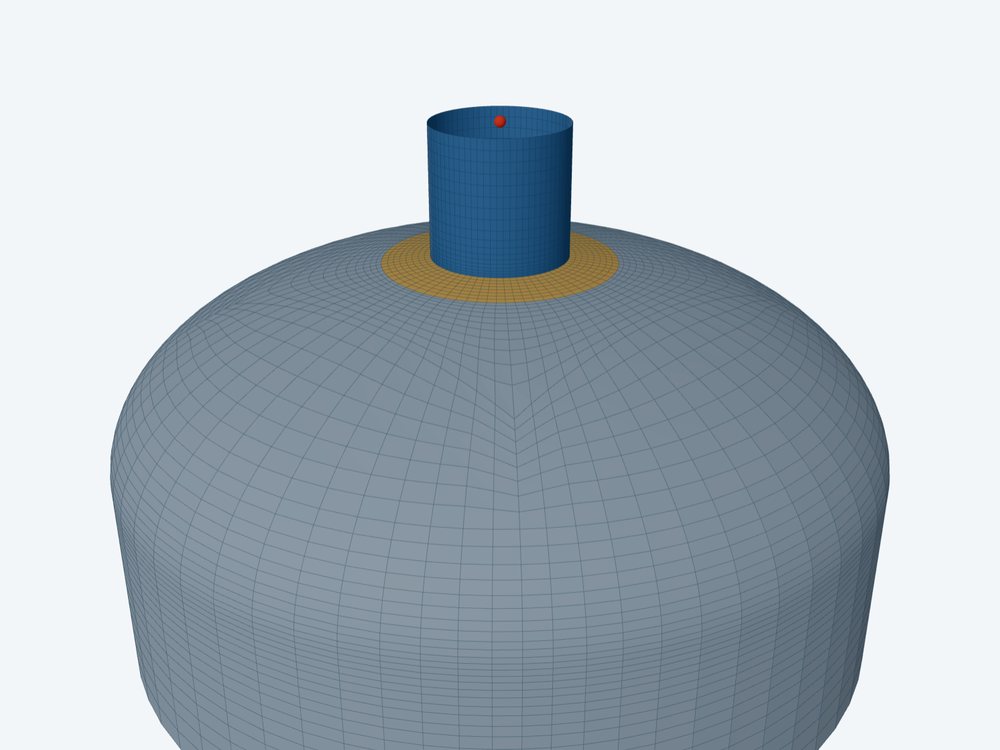
Edge forces at the junction
Cut the vessel at the joint. On the cylinder's edge, and equal and opposite on the head's edge, act a shear force Q₀ and a bending moment M₀, both per unit length of circumference. Each part, loaded by pressure and by these edge forces, must end up with the same radial movement and the same slope at the joint. Two conditions, two unknowns.
For a long cylinder the edge response to each force is classical. With D the wall's bending stiffness and β the decay constant:
A head near its edge behaves much like a short shell of the same radius, so similar expressions apply to it. Add the free pressure growth of each part, set the edge movements and slopes equal, and solve for Q₀ and M₀.
The free mismatch for each head
The edge forces are driven by how far apart the free edges would be. For a cylinder and a head of the same mean radius a and thickness t, the membrane formulas give the free radial growth at the joint:
The 2:1 head's equator moves inward under internal pressure, because its hoop stress there is compressive. The mismatch with the cylinder is then 2·p·a²/(E·t), four times that of a hemisphere, whatever ν is.
The knuckle: hoop stress that turns compressive
A formed head is not a sphere. Its meridian is flatter at the crown and curves sharply near the edge, in the knuckle. For a shell of revolution with meridional radius of curvature R₁ and second radius R₂ (measured along the normal to the axis), the membrane stresses under internal pressure are:
Where the meridian curves more tightly than half of R₂, the bracket goes negative and the hoop stress is compressive. On a 2:1 ellipsoidal head the hoop stress falls from +p·a/t at the crown, through zero where the normal to the head is at about 35° to the axis, to −p·a/t at the equator. That compression is as large as the cylinder's hoop tension.
A torispherical head has a spherical crown and a small knuckle radius, so the change of curvature is sharper and the hoop compression is concentrated in a narrow band. On thin heads of large diameter that band can wrinkle or buckle even under internal pressure, and the knuckle is also where such heads first yield. Design rules for heads limit the knuckle radius and thickness for this reason; the details are code-specific.
Flat heads: the largest edge moment
A flat head carries pressure by bending, and its edge rotates as it dishes. The cylinder welded to it must follow that rotation, so the joint carries a large moment. For a circular plate of radius a, the two ideal edge conditions bracket the real head:
A real flat head sits between the two: the shell partly holds its edge, and in doing so takes a moment that bends the shell hard next to the joint. Flat-head formulas in design codes carry a factor for the attachment detail that allows for this.
Cone junctions: an unbalanced radial pull
A cone under internal pressure carries a meridional force along its slope. At the joint with a cylinder that force has a radial part with nothing on the cylinder side to balance it, so the junction itself must carry it as a ring load:
At the large end it pulls the junction inward and puts a short length of shell in hoop compression; at the small end it pushes outward. For R = 1000 mm, p = 1 MPa and α = 30°, the ring load is about 289 N/mm. Rules require a reinforcing ring or a thicker junction once α passes a code-specific value.
How a junction is checked
The bending that the edge forces cause in the shell is there to keep the parts joined, so it is classed as secondary and judged by its range, typically against about 3 times the allowable stress. The membrane stresses in the head carry the pressure and stay primary. Two exceptions need care: the bending of a flat head across its span carries the pressure, so it is primary bending; and the compressive hoop stress in a knuckle is primary and can govern by buckling. Check your governing code for the exact rules.
Key points
- At a head-to-shell joint an edge shear Q₀ and moment M₀ make the two parts fit.
- A 2:1 ellipsoidal head's equator moves inward under pressure; its mismatch is four times a hemisphere's.
- The hoop stress in an ellipsoidal or torispherical knuckle turns compressive and can wrinkle a thin head.
- Flat heads bend across their span and pass a large moment into the shell at the joint.
- A cone puts an unbalanced radial ring load (p·R/2)·tan α on its junction with the cylinder.
Where this matters in practice
- Nozzles and clips placed in or near a knuckle, where the head's own stresses are already high.
- Thin, large-diameter torispherical heads under internal pressure.
- Flat covers and blind heads welded to a shell.
- Cone-to-cylinder junctions at both ends, with or without a reinforcing ring.
- Shells joined to heads of a different thickness, where the edge forces change again.
FEXLA checks the local stress at a nozzle on a cylinder, a formed head or a cone, from the forces and moments you enter.
See the nozzle checkRelated principles
- Discontinuity stress: making parts fitWhy a stiff part and a flexible part under the same pressure bend each other at the joint, and how far it reaches.5 min read
- Membrane and bending in a shellWhy a curved wall carries pressure by stretching, where it has to bend, and how the two are told apart.5 min read
- Buckling: imperfections and why design factors are largeWhy a shell that looks perfect buckles far below its theoretical load, and how design factors allow for it.5 min read
Next principle: Thermal stress: free expansion and restraint
Educational article. It explains principles and is not design guidance; follow your governing code and edition.