Being added. Load sets are built on a branch of the FEA workbench (ajay/typed-load-sets, 2026-10-31) and are not in the released tool yet. Until they are, the workbench has fixed rows for weight, operating and occasional loads. This note describes the branch as coded.
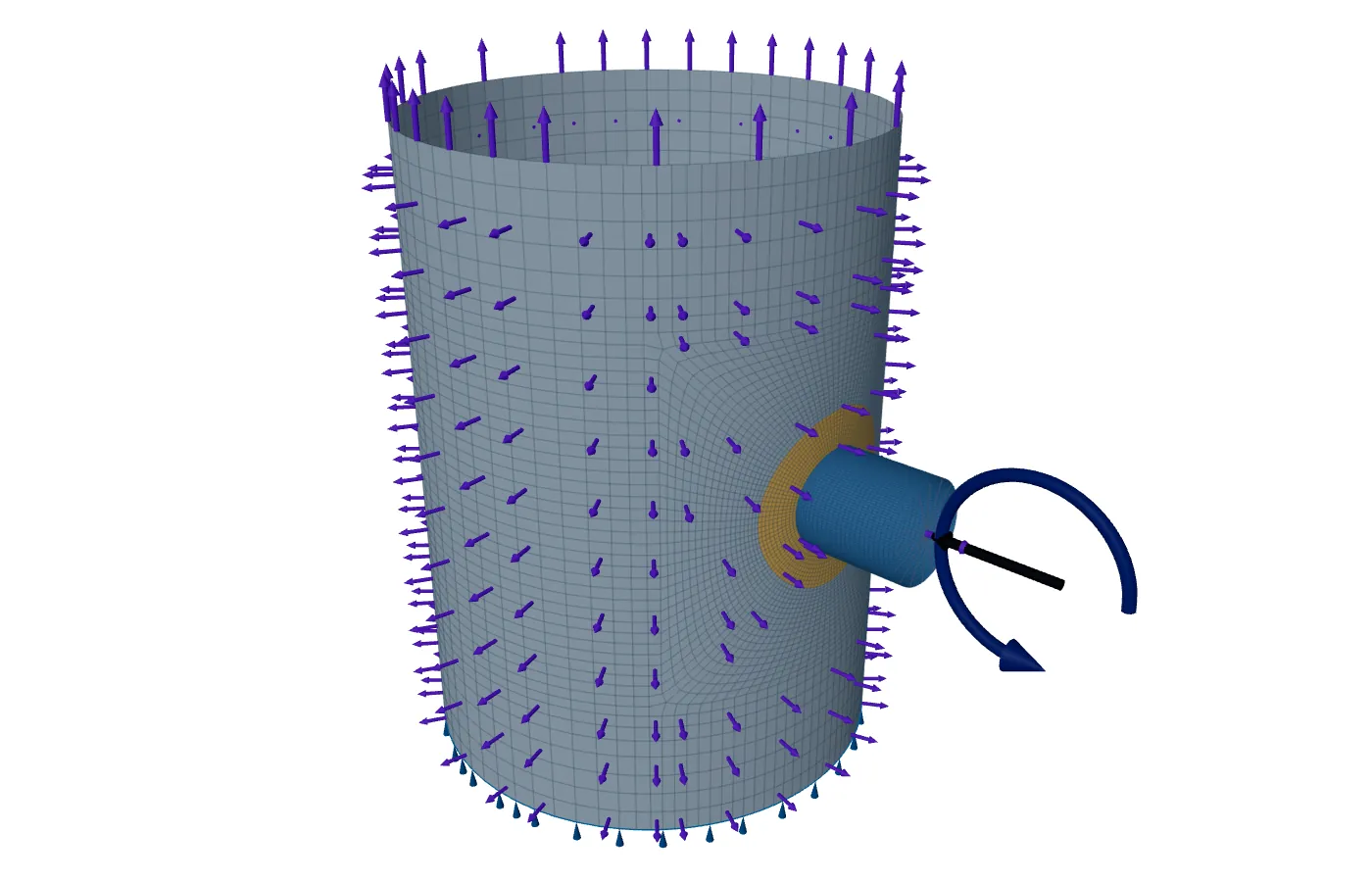
An attachment rarely has one load. A nozzle load table gives the loads for design, for operation, for wind and for an upset, and some of them reverse. The workbench now takes them as named load sets. Each set holds the six loads on every attachment it loads (P, VL, VC, ML, MC, MT, as a force and a moment), the pressure that acts with it, a type, an optional envelope tick and an optional cycle count. Saved jobs from before convert: the weight row becomes a Sustained set, weight plus operating an Operating set, weight plus occasional an Occasional set.
What each type is checked for
- Design (the default): every load treated as primary. Pm, PL, PL+Pb, σ1+σ2+σ3 and the nozzle neck rows, plus the PL+Pb+Q range from zero against SPS. Conservative for loads that include thermal expansion.
- Sustained: the same checks as Design.
- Occasional: the same checks, with no 1.2 increase on the allowables.
- Operating: the PL+Pb+Q range from zero against SPS only, plus the nozzle neck within its reinforcement limit (VIII-2 5.7(a)(1), where every external load counts as membrane). These are self-limiting loads, so they get no primary check, are left out of the limit-load run and enter buckling at 0.88.
Every set that has a pressure is also checked with the pressure off (case LS<i>-0), because a nozzle load without the pressure's tension in the shell can be worse. The dead weight D and live loads L on the vessel act with every set. With a thermal state T in the model, T joins the PL+Pb+Q ranges and never the primary checks.
The envelope: every sign at once
A load table that says ±ML or a load that can act either way is an envelope set. The model is linear, so the code does not solve each sign case. It splits the set into its nonzero components, makes each one a basic case of its own (S<i>c<j>), factorises the stiffness once and solves for all basic cases together. Any combination of signs is then a weighted sum of solutions already in hand. For each row the code builds the full stress tensor of every sign pattern and keeps the worst. Adding absolute values would not do: the equivalent stress of a sum is not the sum of equivalent stresses.
An envelope set is always checked as Design: a load that can reverse is treated as primary. In the limit-load run an envelope set uses the one sign pattern with the lowest elastic first-yield factor; in buckling every pattern is run and the smallest load factor kept. With a cycle count, an envelope set also adds the reversing range between each pattern and its opposite, at twice the set (case LS<i>±).
One nozzle, envelope set with P, VL and ML, pressure 1.5 MPa, no thermal state, no D or L
| Components | n = 3 (VC, MC, MT are zero) |
| Basic cases solved | P, S1c1, S1c2, S1c3: four load vectors, one factorisation |
| Case LS1 (with pressure) | 2³ = 8 sign patterns, primary rows and the PL+Pb+Q range from zero |
| Case LS1-0 (pressure off) | nothing else acts: 8/2 = 4 patterns |
| All six components nonzero | 64 patterns with pressure, 32 without |
| Allowables, S 138, Sy 260, Su 485 MPa | Sy/Su = 0.54: SPL = max(207, 260) = 260 MPa; SPS = 260 + 260 = 520 MPa (above 3S = 414, allowed since Sy/Su ≤ 0.7) |
Sy,cold = Sy,hot = 260 MPa is assumed here; the tool takes the yield at each end of the cycle from its material table.
Limit load, buckling and cycles
- Limit load: each non-operating set as D, in two combinations, 1.5(P + D + S) and 1.3(P + D) + 1.7S, each also with P = 0. Operating sets are left out.
- Buckling: each non-operating set as D; operating sets at 0.88.
- A set with a cycle count is a fatigue event from zero to the set. Ranges between two counted plain sets (case LR<i>.<j>) are the difference of the two states, so D, L and T cancel.
- The vessel's own wind or seismic row stays a row (0.6W or 0.7E in the elastic checks, 0.71 in buckling) and can be enveloped on its own.
Where it stops
- One set acts on all its attachments at once with one shared sign pattern. Loads that reverse independently on two nozzles need two sets.
- The type is the engineer's call. A displacement-driven load entered as Operating gets no primary check; if it is not truly self-limiting, enter it as Design.
- Old jobs' "reverses" option becomes an envelope on that set (all primary), which is conservative against the old second, flipped set. This and the other conversions wait for the owner's confirmation.
- Run times of envelope buckling and limit load on large models were not measured on the branch.