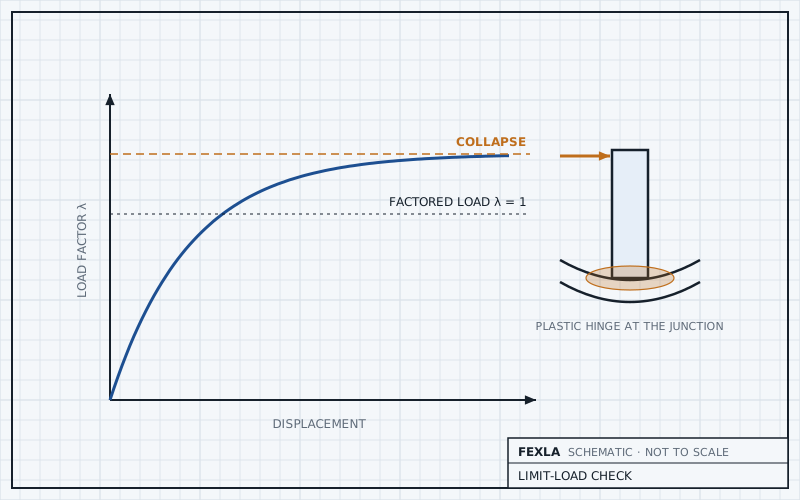
When a nozzle, lug or trunnion fails the elastic primary stress check by a small margin, ASME Section VIII Division 2 offers another route for protection against plastic collapse: a limit-load analysis, 5.2.3. It asks whether the part still finds an equilibrium under the factored loads when its material is elastic and perfectly plastic, yielding at 1.5S without hardening.
If it does, the elastic primary checks are replaced for that part. Nothing else is.
Why the elastic check can be too strict
An elastic check sorts the computed stress into categories and limits each. At a junction the sorting is hard: is the bending there primary or secondary? A conservative choice can fail a part that has plenty of reserve, because a section only collapses once yielding has spread through it. A limit-load analysis does not sort anything. It lets the metal yield and watches whether the load is still carried.
What the analysis solves
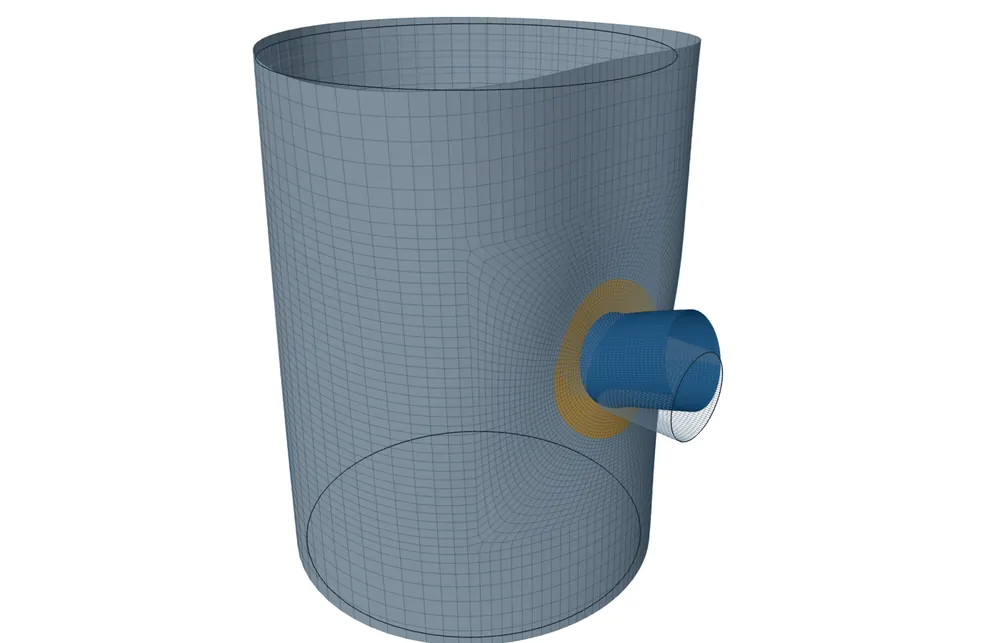
Each point through the thickness of each shell element yields by von Mises at κ = 1.5S of its part, with no hardening. Five points through the thickness put the mid-surface on a panel boundary, which makes the fully plastic moment exact, Mp = σy·t²/4 per unit width. Displacements are small: equilibrium is written on the undeformed shape.
The load factor is raised in steps. A step is cut when Newton's method fails and grown again when it is easy, down to a smallest step of 10⁻⁴. The run ends as a limit when the stiffness goes singular, or at the smallest step on a plateau. A plateau stop is a lower bound on the collapse load, never a bracketed margin.
The combinations
Table 5.4 is applied to the load rows, each combination its own load path from zero, because plastic results cannot be added up: 1.5(P + D); 1.3(P + D) + 1.7L; 1.3(P + D) + 1.1L or 0.54W; with wind 1.3(P + D) + 1.1W + 1.1L; with earthquake 1.1E; and the test condition. Pressure not acting, L not acting and reversed occasional loads are run too. Thermal and displacement-controlled loads are left out: they do not change an elastic-perfectly plastic limit.
A combination that is a smaller multiple of one that already converged is covered without a run of its own.
Pass, fail and not assessed
- Pass: the path converged at λ = 1, or the combination is covered.
- Fail: no equilibrium below λ = 1.
- Not assessed: out of budget, cancelled or a solver error. Never a pass.
- After a pass the run can continue to λ = 3 to find the collapse factor. It is reported as a margin only when the stop is a singular stiffness bracketed within 0.2 %.
What a pass means, and what it does not
A pass shows that the small-displacement, perfectly plastic model does not collapse under the factored loads. In a run with both checks, a passing set replaces only the elastic primary stress rows. It says nothing about local strain (5.3.3), stiffness lost to shape change (5.2.4), buckling (5.4), fatigue or ratcheting, and those checks stand as they are.
Two warnings come with it. Walls with Rm/t of 4.5 or less: a shell model drops the through-wall stress, measured conservative by 1.1 % to 3.4 % against a solid. And parts loaded mainly in bending, which 5.2.1.3.2(b) singles out.
Where it stops
- 01The VIII-2 route only: S must be the Division 2 value.
- 02Collapse of the modelled part, not of the whole vessel.
- 03Large-displacement elastic-plastic analysis (5.2.4), the strain limit (5.3.3) and elastic-plastic ratcheting are not done. Ratcheting is checked by the elastic Bree diagram only.
- 04The job refuses models above 15 000 elements and warns above 5000.
- 05The limit-load analysis is early access and under verification; its agreement figures are against closed forms, an independent solver and a published example, not an independent review.
Try it in FEXLA
The Limit-load check card runs the 5.2.3 analysis on the shell model you built, every Table 5.4 combination, and reports pass, fail or not assessed for each.
Open the cardReferences
- ASME Section VIII Division 2, Part 5: 5.2.1.4, 5.2.3 (limit-load analysis), Table 5.4, 5.2.4, 5.3.3, 5.4.
Method notes this draws on
Next post: API 661 plug headers to Appendix 13
Educational article. It explains principles and is not design guidance; follow your governing code and edition.