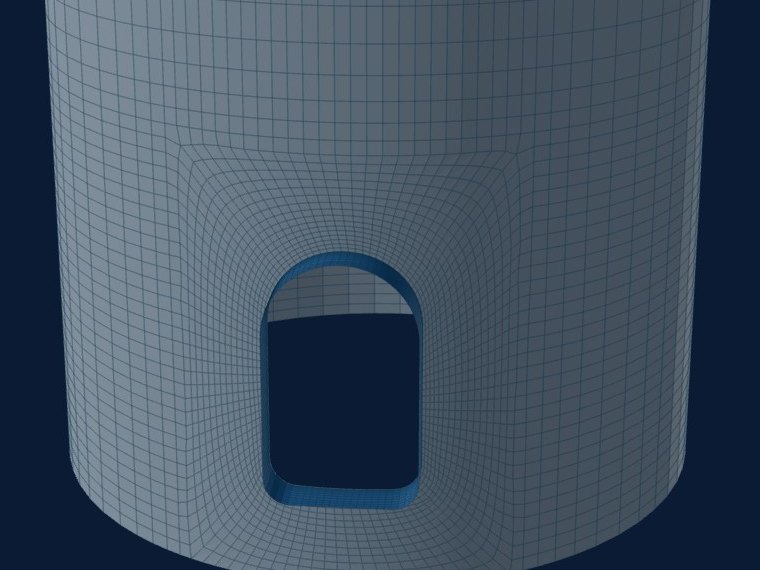
WRC 537 has curves for round nozzles and rectangular attachments only, so it gives no stress for an obround or tombstone opening. These shapes go to a shell model, which meshes the real outline on the shell or head and reports the stress round all of it. In a skirt the same shape is built by the skirt opening job, which adds a buckling check.
This post covers how the two shapes are described, how the model builds them, and the limits of what is built today.
The two shapes
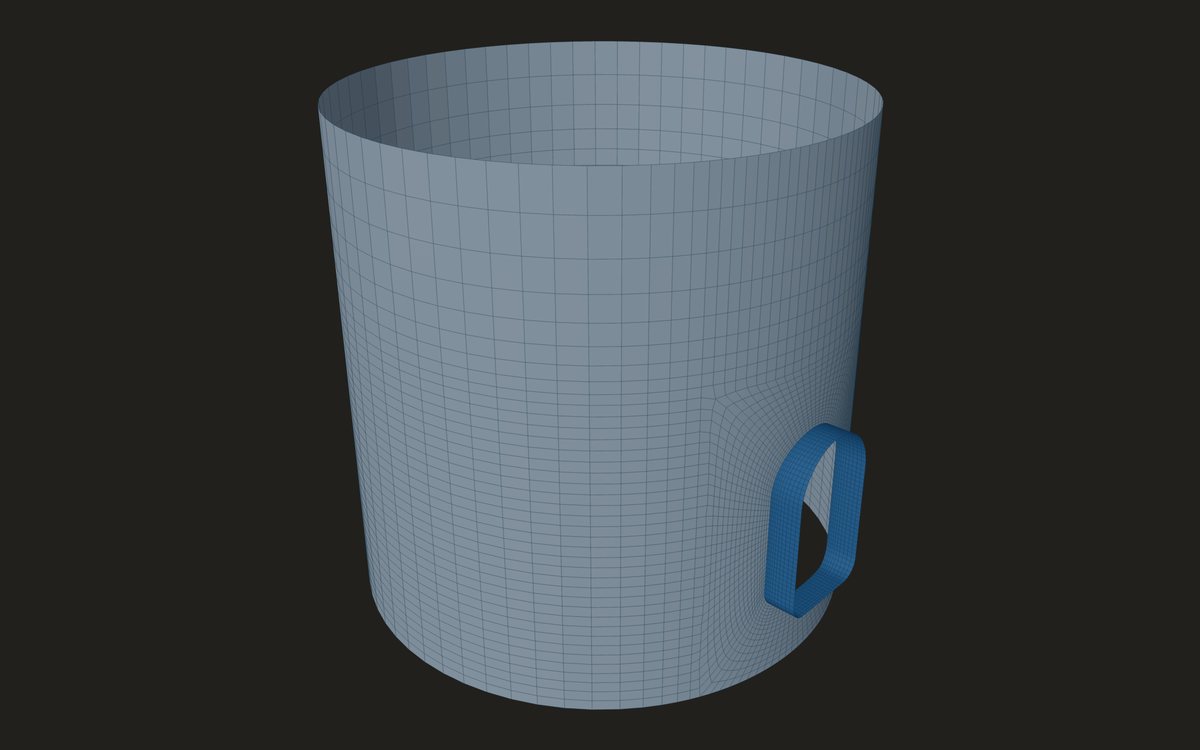
An obround is two semicircles joined by straight sides: a round nozzle stretched along one axis. It is given by its outside width, which is the diameter of the semicircles, and its outside length along the long axis. The length must be more than the width, or the shape is just round.
A tombstone has a semicircular arch at one end, straight sides and a flat bottom with rounded corners. It is the usual shape of a skirt access opening. It is given by the width, the overall length, and the corner radius, which must lie between the wall thickness and half the width. At half the width the corners become semicircles and the tombstone is an obround.
| Input | Obround | Tombstone |
|---|---|---|
| Outside width | Diameter of the semicircles | Diameter of the arch |
| Outside length | More than the width | At least the width |
| Corner radius | None | Wall thickness to half the width |
| Long axis | Angle from the vessel axis | Angle from the vessel axis; at 0 the arch points along it |
| Pad | Width and length, same outline | Same outline, corners offset |
Why the bulletin cannot be stretched to fit
It is tempting to call an obround a round nozzle of some equivalent diameter, or a rectangle of the same footprint. Neither is in the bulletin, and neither captures what the shape does. A round opening spreads load evenly round its edge. An obround has two straight sides and two tight ends where load gathers. A tombstone adds two corners whose radius sets how sharply it gathers there.
The direction of the long axis matters too. On a cylinder the hoop and longitudinal stresses differ, so an opening long along the vessel axis and one long round the circumference interrupt different load paths. The long-axis angle is therefore an input, measured from the vessel axis toward the circumference. A single equivalent size would hide the difference.
Inputs that change the answer
- The corner radius of a tombstone. The smallest allowed is the wall thickness; a larger radius spreads the load round the corner.
- The long-axis angle. Try both directions when the layout leaves a choice; the model shows which one the shell carries better.
- The pad. It follows the opening's outline. An obround pad is given by its width and length; if the length is left out it takes the nozzle length plus the same margin as the width.
- The wall of the sleeve or nozzle, and its projection outside and inside the shell. The sleeve carries part of the load round the opening.
Each of these is a dimension on the drawing, so a change is a new run of the same model rather than a new method.
How the shell model builds the opening
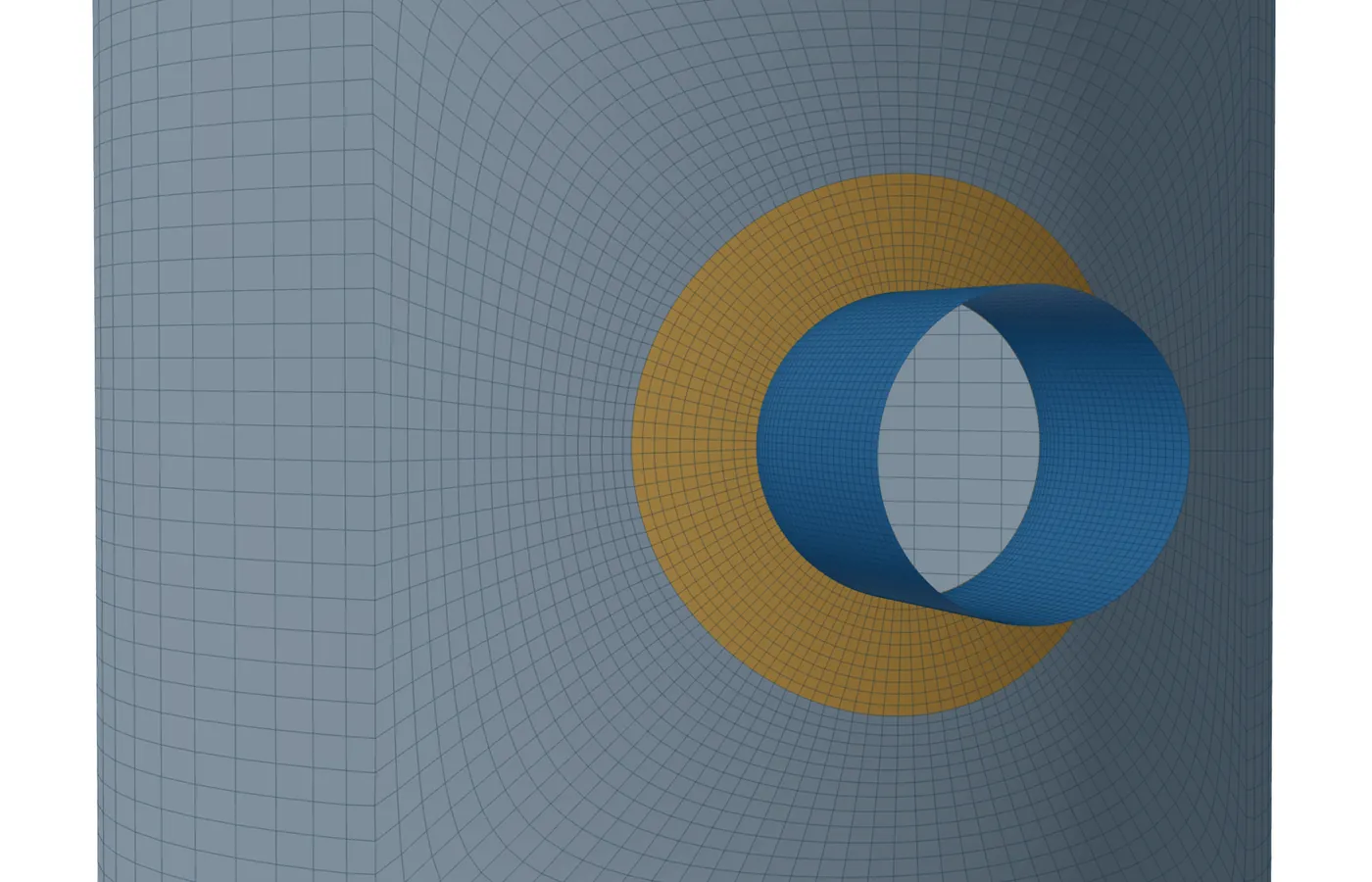
The opening is a nozzle with a non-round cross-section. Its outline is a smooth, convex curve round the nozzle axis, so every line out from the axis meets it once, and the mesher only needs the distance to the curve and its normal at each angle. For a tombstone the wall's mid-surface is the outside curve offset inward by half the wall, so the corners keep their true radius.
The shell grid round the opening is replaced by rings of elements running in to the exact intersection of the barrel and the shell, and to the pad edge when a pad is fitted. The pad follows the opening's outline. Element size is set by the decay length √(R·t), the same rule as for a round nozzle.
Shell elements give the membrane and bending stress directly, so the stresses round the whole outline are sorted into the categories of ASME Section VIII Division 2, Part 5. The worst point is found, wherever on the outline it lies.
In a skirt
A skirt access opening is usually a tombstone with its arch at the top. The skirt opening job builds the whole skirt from the base ring to the head joint, with the opening's sleeve, an optional pad and stiffener bars either side. It loads the skirt with the weight and the wind or seismic moment, turned so that the opening side is in compression, and always runs a buckling check. The post on skirt access openings follows that job step by step.
Where it stops
- 01Only the first attachment of a model can be obround or tombstone; nozzles two to four are round.
- 02A heavy barrel, gussets and a tangential axis are available on round nozzles only.
- 03The optional solid detail at the junction takes round nozzles only, so weld-toe peak stress at a non-round opening is not resolved.
- 04Opening reinforcement for pressure is not sized here; take it from your vessel program.
- 05The finite-element results, and the non-round shapes in particular, are early access and under verification. Until that is finished they are not a source of design values.
Try it in FEXLA
The Nozzle loads card runs WRC 537 on round nozzles and opens the shell model, where an obround or tombstone opening can be built on a shell or head.
Open the cardReferences
- WRC Bulletin 537: Precision Equations and Enhanced Diagrams for Local Stresses in Spherical and Cylindrical Shells due to External Loadings.
- ASME Section VIII Division 2, Part 5, Design by Analysis.
Method notes this draws on
Next post: Nozzles on formed heads: the spherical region, the knuckle and WRC 537
Educational article. It explains principles and is not design guidance; follow your governing code and edition.